

Harvey Ball, Franklin Loufrani and the face that belongs to everyone
One drew a smile for 45 dollars and never trademarked it. The other gave it a name and built a licensing empire on it.
Ten minutes in Worcester
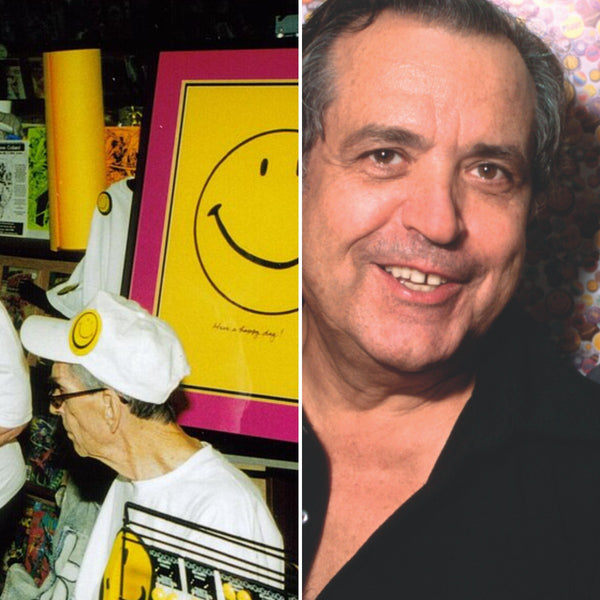
In December 1963 the insurance company State Mutual Life Assurance of Worcester, Massachusetts, had a problem: after a merger with another firm, its employees were walking around downcast. Management came up with a “friendship campaign” and commissioned artwork from a local commercial artist and Second World War veteran — Harvey Ball. Ball sat down and drew a yellow circle, two oval eyes and a smile. It took him about ten minutes. He was paid 45 dollars.
The original was not perfect — one eye is slightly larger than the other, and the smile is not quite symmetrical. Drawn by hand, not with a compass. The company printed the first hundred buttons; by the end of the campaign it had handed out more than a hundred thousand.
A face without an owner
Neither Ball nor the company trademarked the drawing. In the early 1970s the brothers Bernard and Murray Spain, who owned card shops in Philadelphia, added the slogan “Have a Nice Day” to the face and began mass-producing it. By 1971 more than 50 million smiley buttons had been sold.
Ball never earned another cent from it. His son recalled that his father never regretted it — he preferred letters of thanks from all over the world to royalties. He founded World Smile Day, celebrated on the first Friday of October. He died in 2001. There is a smile on his gravestone.
The simplest drawing in the world also turned out to be the hardest to keep for oneself.
Good news in Paris
On the other side of the ocean, Franklin Loufrani, a French journalist and licensing specialist, had had enough of headlines about the Vietnam War and Nixon. He proposed a campaign to the daily France-Soir: “Prenez le temps de sourire” — “Take the time to smile”. Every piece of good news in the paper received a mark: a yellow face. The campaign launched on 1 January 1972. That yellow smile was reportedly the first colour ever to appear on the newspaper’s black-and-white front page.
Loufrani did what no one in America had done: he registered the face as a trademark and gave it a name — Smiley. He printed ten million stickers and gave them away for free. The first licences soon followed, among them Mars chocolate dragées with a smile on every single one.
From sticker to brand
In 1996 the company was taken over by Franklin’s son, Nicolas Loufrani, who founded The Smiley Company in London. He registered the brand in around a hundred countries and turned the logo into a lifestyle. Today Smiley works with hundreds of licensees — from Nutella and McDonald’s to Moschino and Fendi — and the company donates part of its profits to its own charitable foundation. The smile even appeared at the opening ceremony of the 2012 London Olympic Games.
Two stories
So who invented Smiley? Just put the two faces side by side.

The resemblance is hard to miss. Design historians usually credit Harvey Ball as the author of the drawing that spread across the world. The Smiley Company stresses that Franklin Loufrani was the first to register the smile and turn it into a brand. Both are true. Ball gave the world a face. Loufrani gave it a name — and an owner.
And that same yellow face leads straight to the emoticons and emoji we type every day. Few drawings have lived such a long life.
Eras of the smile
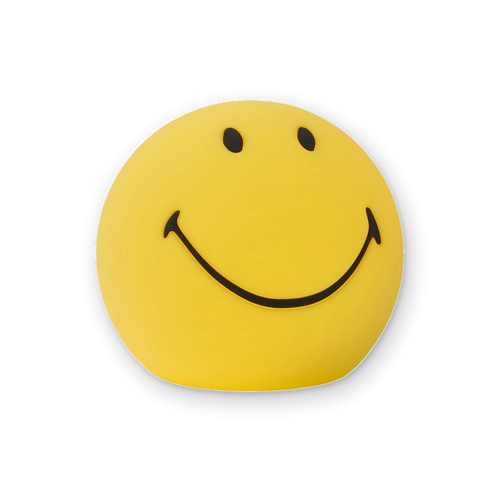
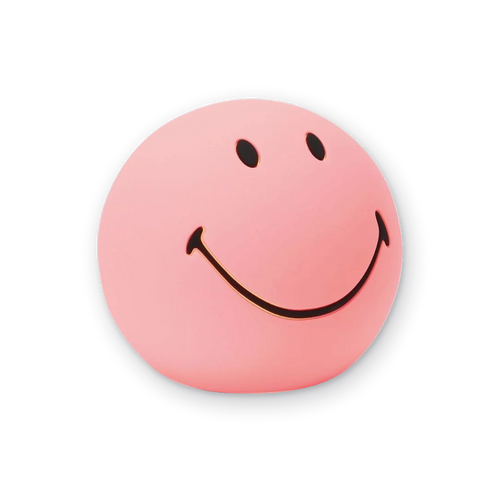
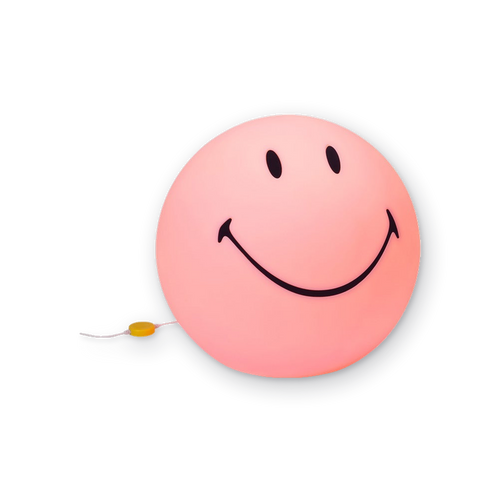
Smiley lamps by the Dutch studio Mr Maria are waiting for you at Kickomi — in yellow and pink, from 11 to 40 cm.
See the lamps →Read also: Miffy: Dick Bruna · Lava lamps are back · Follow: Smiley