Skullpanda: Petals in Four Acts. The flower as a story about life
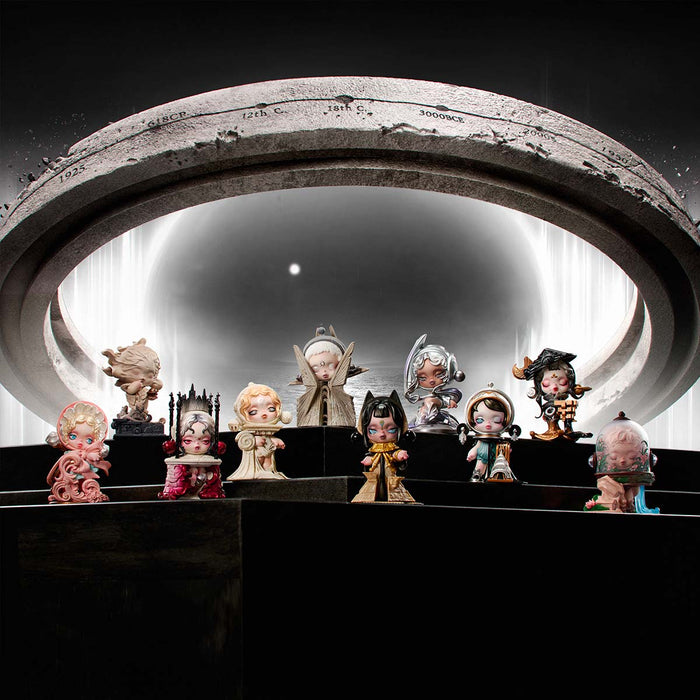
Some series you collect, and some you read. Petals in Four Acts belongs to the second kind. Skullpanda — the most dramatic, most "grown-up" of the Pop Mart characters — isn't telling her own story this time. She's telling the story of a flower. Or rather, our story, told in the language of petals: sprouting, blooming, wilting and falling — the whole arc of a single life written out in four acts.
Behind Skullpanda stands Xiong Miao — the artist who created a character of a thousand faces, able to slip into new moods and eras like an actress changing costumes. Petals in Four Acts is one of her most cohesive performances: not a set of variants, but a drama in four scenes. Whether you're just entering Skullpanda's world or have been collecting her for years and want to understand what this series is really about — this guide takes you through it act by act.
Flowers sprout, bloom, wilt and turn to dust — and in decay they give birth to new life. This isn't a series about flowers. It's a series about impermanence.
How to read Petals in Four Acts
This series isn't a set of pretty figures to line up side by side. It's one story in four chapters, in which the flower — and Skullpanda with it — passes through the whole cycle of existence. All four acts are hidden in one blind box: you open the sealed box and only then discover at which stage of the journey fate has paused, placing a particular figure in your hands.
What sets Skullpanda apart on the Pop Mart shelf is her emotional maturity. Other characters want to be sweet — Skullpanda wants to be true, even when the truth is melancholic. The four acts form a journey through states we rarely name out loud: hope, fullness, fragility and acceptance. They read best in order — the way a flower lives.
The four acts in order
From the first push towards the light to the last falling petal — a whole life written out in four stages. Every figure in the series belongs to one of them.
Act I — Sprouting: birth and hope
The beginning. Innocence, life's first push towards the light, a promise that knows nothing yet of the end. An act of pure potential — that moment when everything is still to come and the petals are still tightly furled. The brightest, most soothing part of the story.
Act II — Blooming: passion and fullness
The peak. Fully open, beauty at its most intense, confidence and radiance. An act about being fully yourself — brief, dazzling and, like every bloom, fleeting. The most sensual and colourful scene.
Act III — Wilting: reflection and fragility
The turn. The first signs of impermanence, fragility, quiet reflection. The most Skullpanda of the acts — because melancholy is where this character feels most at home. For those who like a figure that carries a sense of contemplation.
Act IV — Falling: decay and rebirth
An ending that is a beginning. Falling petals, decay — but hidden within that decay, the seed of new life. An act about acceptance and about the fact that no ending is final. The deepest, most symbolic part of the series.

A poetic series about impermanence and the seasons of life, told through flowers in four acts. You open the box without knowing which scene will join your collection.

The secret, the designs and the hunt
The series includes several designs plus one secret. The names of the individual figures read like chapter titles in a poem — among them The Invitation of Light, The Burning Gloom, The Withered Innocence, The Crown in Ashes, The Vow and The Elegiac Witness. Each belongs to one of the four acts, and together they complete the cycle.
And watching over them all is the secret: Chronos' Gardener — the Gardener of Time, the rarest figure in the series, the one every collector is looking for and only a lucky handful pull.
The secret isn't just a rarity. It's the punchline of the whole story — because if the flower's cycle measures time, someone has to be its gardener.
From blind box to Harrods
It's worth pausing on how this series entered the world, because it says everything about the direction Pop Mart is heading. Petals in Four Acts debuted in April 2026 not in a shop, but as a curated exhibition — simultaneously at Harrods in London and in Amsterdam. On the fourth floor of Harrods, Pop Mart's permanent space was transformed into a narrative floral installation, act by act.
It's the same move that built the previous series, The Feast Begins, shown in London and Paris. The designer figure stops being a product on a shelf and becomes an exhibition object — something you look at like art before you buy it. For us at Kickomi, this is exactly the story we've been telling from the start: an art toy isn't a toy, it's small art. It's nice to see the biggest player on the market saying the same thing in the language of Harrods.
Who this series is for
Petals in Four Acts is a series for those who look for something deeper than sweetness in art toys — less "aww", more emotions we're not afraid to look in the eye.
- If you like a collection that means something — this is a series about impermanence and rebirth, not just a pretty object.
- If you're drawn to melancholy with class — the wilting and falling acts are for you.
- If you're just starting out with Skullpanda — this is one of the most beautiful ways into her world.
- If you're on the hunt — Chronos' Gardener is waiting. Good luck.
And if you'd like to get to know the artist who brought Skullpanda to life — we've written about her separately in the Artists: Skullpanda — Xiong Miao section. She is her alter ego: a freer, louder, boundless character, in which a sweet form and an uneasy mood live under one roof.
Specification
Petals in Four Acts is waiting at Kickomi.
View product →